

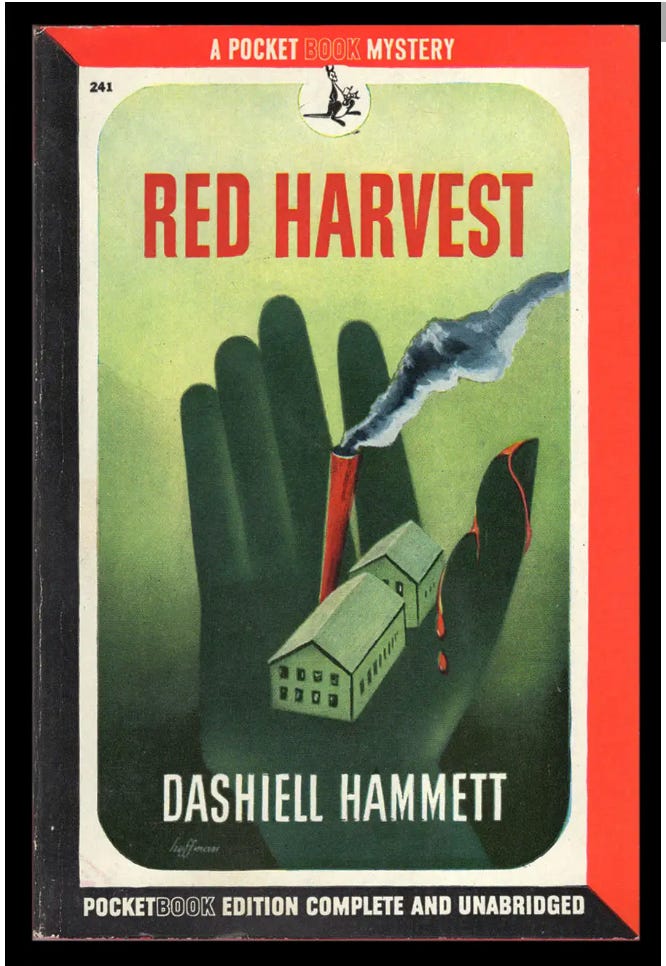
The crime novelist Dashiell Hammett opens Red Harvest, his first novel, at a casual gait, his tone almost folksy. I first heard Personville called Poisonville by a red-haired mucker named Hickey Dewey in the Big Ship in Butte. He also called his shirt a shoit.
Jack London vibes here, with a twist of Damon Runyon—or maybe we’re in a yarn-spinning Mark Twain version of the West, updated for Hammett’s late 1920s. These sentences give no hint that we’ve entered a bloody funhouse of murder, deceit and bare-knuckled politics under extractive industrial capitalism. But such indeed are Red Harvest’s delights.
“The last word in atrocity, cynicism and horror,” said French Nobelist André Gide (expert in all of the above) re: this novel. One could argue that’s measured, and I defy anyone to count the corpses on first read. Shootouts. Assassinations. Jailbreaks. Bank robberies. A rigged boxing match that ends in a long-range knife-throwing. Ice-pick stabbings, torched roadhouses, laudanum trips—we ride the lightning all the way. The first murder is solved on page 61 of my copy, soon forgotten. Many characters die before a moment of life on the page; pour one out for Yakima Shorty, gunned down in a millionaire’s bedroom, and for so many others.
A weird book, then—and, more than many other more eminent and “better” novels, a cultural turning point. Red Harvest has long figured as a sort of B-side literary landmark, inspiring Kurosawa and the Coen Brothers, Deadwood and every story about a private eye fueled by gin and vengeance. Sharp ears detect resonance between Hammett and Hemingway. For these reasons and more, I have spent a lot of time thinking about Red Harvest: as a source-code for crime fiction across media; as an intense urban-Western-horror artwork, spooky and avant-garde; and as a story set in Montana, my home state, where it doesn’t seem to belong. This ‘zine’s title pays tribute. And so we go now down the mean streets of Poisonville, in the company of a lot of people who are also very mean.
I first encountered Red Harvest in The Last Best Place1, an 1,100-page doorstop anthology and late-’80s staple of every readerly Montana household. That collection includes Hammett’s first chapter, alongside Vigilante gems like “The Execution of ‘The Greaser’ and Dutch John,” a Richard Brautigan extract and everything else.
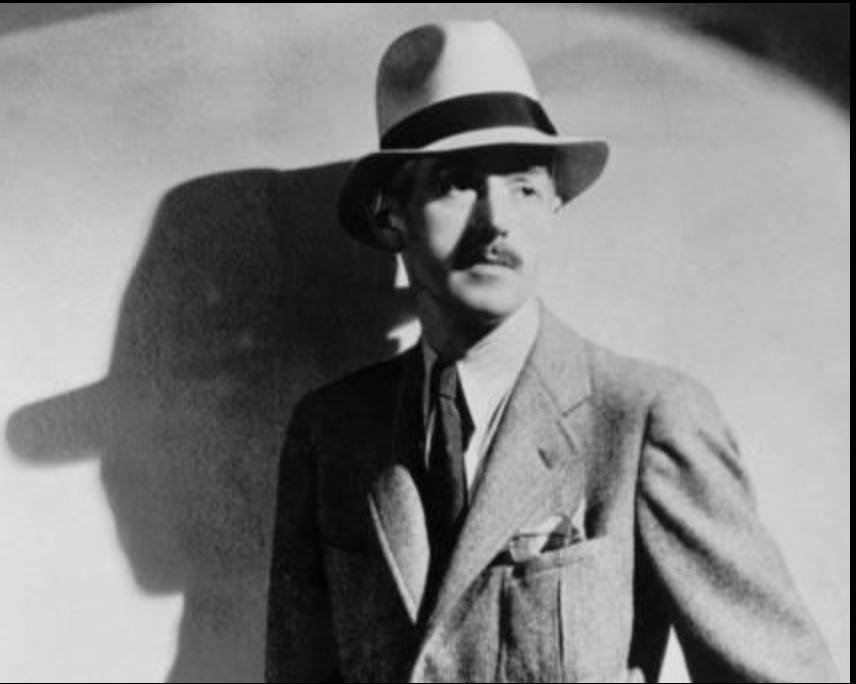
We find Dashiell Hammett2, smashing out pages in an apartment on Post Street in San Francisco, his mind wandering a remote mining city.
Most of its builders had gone in for gaudiness. Maybe they had been successful at first. Since then the smelters whose brick stacks stuck up tall against a gloomy mountain to the south had yellow-smoked everything into uniform dinginess. The result was an ugly city of forty thousand people, set in an ugly notch between two ugly mountains that had been all dirtied up by mining. Spread over this was a grimy sky that looked as if it had come out of the smelters’ stacks.
I stumbled into this grim scene as a young punk who’d graduated from Sherlock Holmes to Black Lizard paperbacks. I had probably already read The Maltese Falcon. But Red Harvest’s nameless narrator, the Continental Op, was new to me, and here he was, reporting from Montana; from Butte, it seemed, given a different name (Personville / Poisonville) and a thin alibi in that first sentence.
Short story goes, 19th Century Butte was a played-out silver camp that switched to copper, and its copper mines became a global labor magnet. Between the industrial barons who owned the mines and the workers who operated them, in its salad days Butte ran around the clock, a blue-collar mini-metropolis on the Continental Divide, by repute a sort of Floating World of death and debauchery. The money was colossal. Montana orbited around Butte for decades, and the city became a cultural powerhouse, too, for its motherlode of characters, myths and lore.
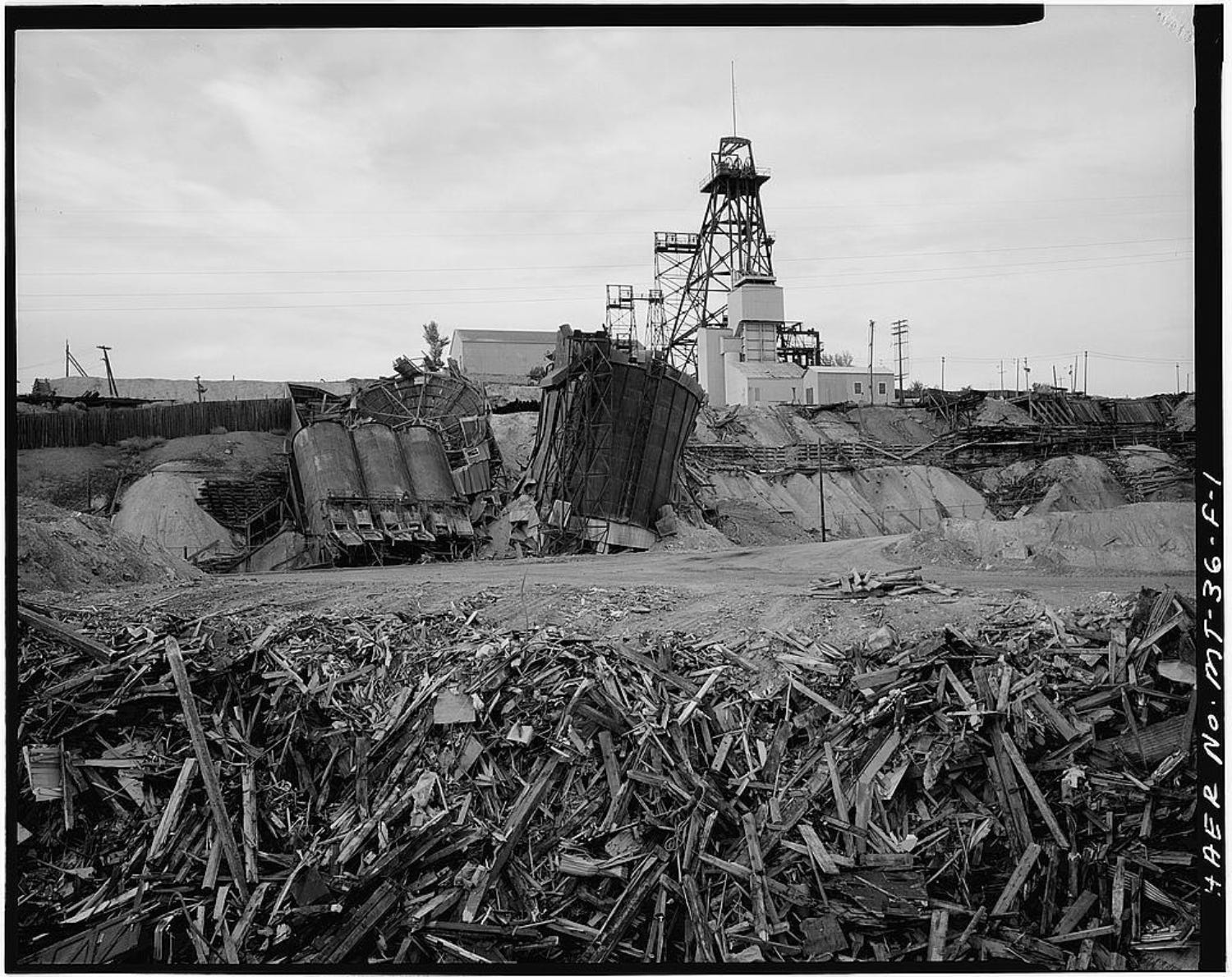
Red Harvest fictionalizes a bit, as Hammett transplants those smelter stacks from nearby Anaconda to crank the intensity. But Red Harvest unfolds in Butte for sure—or a fever-dream Butte, which Hammett reimagines as the archetypal noir landscape.
Anyone reading American books or watching American films or TV throughout the near-century after Red Harvest’s 1929 publication encountered Poisonville’s citizenry many times over. Here, we meet our bent cops; our warring hoodlums with sinister nicknames and sidelong accents; the boozed-up shamuses too cynical to care about anything but the job. Dinah Brand, Hammett’s female lead, codifies the tough-talking dame who knows the score. “What’s the rumpus?,” the Op asks, as he surveys a Poisonville scene—and the line will echo decades later in the Coens’ Miller’s Crossing. The rumpus, writ large, is a battle for control of the city, setting one of the hardboiled genre’s ur-themes: with its tale of money, violence, political and informal power, this short novel adds to the national mythology. And it’s funny!
*
The Continental Op arrives in Poisonville on the job for a national agency, summoned by a crusading newspaper editor. That guy gets snuffed immediately, so instead The Op deals with his father: “the Czar of Poisonville,” copper oligarch Elihu Willsson. (In his novels, Hammett favors antic plots, brief encounters. You have to be drunk to follow The Thin Man, and Falcon is a triumph of atmosphere, character and dialogue, not logic.) Willsson owns the mines, but lost the streets after importing “gunmen, strikebreakers, national guardsmen and even parts of the regular army” to crush a labor uprising led by the radical Industrial Workers of the World. The hired thugs stuck around and took Poisonville’s rackets and dives for themselves. Willsson—a ragey invalid who never leaves his mansion, thus a template for several future Raymond Chandler characters—hires the Op to retake the city.
All this tracks Butte’s real history in the way of a bleary-eyed barroom retelling. (In fact, the Op learns Poisonville’s backstory in a booze session with an I.W.W. operative.) The years preceding the novel really did see extraordinary chaos and violence in Butte, as workers battled the powerful Anaconda Copper Mining Company, and Anaconda annihilated its rivals. A bomb leveled Butte’s central union hall—never solved. Masked vigilantes lynched Frank Little, a famed I.W.W. organizer—never solved. Gunmen opened fire on demonstrators during the so-called Anaconda Road Massacre—never solved. Rival newspapers on left and (especially) the right raved. Authorities called in the army more than once. The outcome, both in the real Butte and Hammett’s description: When the last skull had been cracked, the last rib kicked in, organized labor … was a used firecracker.
Red Harvest also chimes with a bigger story of class struggle America, particularly the West. In the first season of our podcast Death in the West, my co-creators and I delved into I.W.W. activist Frank Little’s unsolved murder in Butte. We soon found ourselves neck-deep in violent labor conflict in the 19th and early 20th Century, a sweeping story that rarely gets told, one that bloodied just about every Western state. I could tell tales of Colorado mining towns, Idaho bombings and Arizona deportations that would raise the hair on your neck. (Stay tuned!)
Famously, Hammett brought first-hand experience to the page; he’d worked as Pinkerton National Detective Agency operative, serving an outfit hated across the West for breaking strikes and infiltrating unions3. In his time with the nation’s pre-eminent private detective firm, he became an ace shadow-man but developed contempt for the agency’s corporate clients. He would later claim he was personally offered $5,000 to kill Little, a story most historians charitably consider a metaphor, see, indicative of the times. Did he ever actually visit Butte during his Pinkerton stint? The record is silent, but Red Harvest’s richly evoked atmosphere serves as compelling evidence that he must have seen the place.
Hammett could have written a literal tale of Butte history, and it would have been fascinating. That’s not Red Harvest. Hammett created an improvisatory riff, keeping the broad strokes of moral narrative, condensing the energy and inventing the details. Similarly, the novel borrows from cowboy and outlaw tales that filled the era’s pulp magazines, but subverts them like a 1970s revisionist Western. The storytelling saw about “a stranger comes to town” ignites, in Red Harvest, pure mayhem.
*
Once hired by the mining baron, the Continental Op aims to foment war between criminal factions and Poisonville’s dirty cops. He’s very successful. While the Op does do some genre-standard detective work, this is by no means a “mystery” novel; dozens of people die in the chaos he unleashes, and who kills whom hardly matters. Blame the Great War, maybe. Hammett’s people fight their way through an abandoned amusement park, dusty warehouses, shotgun shacks, a seemingly endless network of hotels and bars. Borges, we found your labyrinth, man—a city with no parents, no children, no churches, no leaders who aren’t packing heat, no end of places to die. (In an early scene, Hammett sketches Poisonville society: “... men from the mines and smelters still in their working clothes, gaudy boys from pool rooms and dance halls, sleek men with slick pale faces, men with the dull look of respectable husbands, a few just as respectable and dull women, and some ladies of the night.”)
Characters drift in and out of the narrative almost at random, some of the most memorable vanishing into its red mist without explanation. At one point, the Op complains that he’s gone “blood simple like the natives,” and a reader suspects this might be Hammett himself, testifying from the eye of his own storm.
With hindsight, Red Harvest reads as a last call for the Roaring Twenties. Hammett published it first as serial installments in Black Mask, the definitive pulp magazine; it caught the sharp eye of Blanche Knopf, who worked editorial magic to refine the novel into what it is. The book came out on February 1, 1929—exactly two weeks before the Valentine’s Day Massacre in Chicago, about nine months before Wall Street crashed. In its pages, Hammett harvested the decade’s dark politics, the violence and repression that lurked beneath the Jazz Age.
One interesting question for me, on first read and most recent read, is to what degree Red Harvest is a Western story—specifically, a Montana story.
Even the most critical Montanan reader has been conditioned to expect some pastoralism in their home-state fiction, some version of “Last Best Place”-type sentiment, traded on in different ways by A River Runs Through It and Yellowstone. (There are, of course, many traditions in Montana storytelling, not all bucolic or beholden to a notion of the state as a place apart. I’m talking dominant narratives here.) In Red Harvest, Montana is not only not unspoiled, it’s completely spoiled. In Poisonville, Hammett creates a city devoid of community, a place where only money and power matter—a place built on extraction and nothing else. (For all its many qualities, Montana does use “Oro y Plata” as its official motto—“gold and silver,” none of this brotherhood-of-man stuff.)
This novel vibrates to the West’s most sinister frequencies, the coldest bands of its emotional register. Its world is the product of violent conquest, ruthless industry and rootless drift in a place undefined by convention. Not the whole Western story, by any means—but one of them, authentically hallucinated by someone who did his time on the region’s raw edges. Red Harvest doesn’t pose this question straight out, but what’s the legacy of colonialism? As another Western writer might put it, ask the dust.
Edited by William Kittredge and Annick Smith, two legends.
When I interviewed Julie Rivett, Hammett’s granddaughter and literary steward, some years ago, I learned that the sanctioned family pronunciation is “Dash-eel.”
Nathan Ward’s book The Lost Detective explores Hammett’s Pinkerton years.
Loved this book since I was a kid, and bought a third edition a long time ago. I have always felt this novel had some relation to Hemingway's Big Two-Hearted River, maybe its inverse. Hemingway created an atmosphere for a fishing story, by never invoking its backstory: a soldier home from war. By its absence, the war enters the story. Red Harvest, on the other hand, wades through its own blood, and the feeling of ever-increasing darkness is the principal effect of the last third of the novel. That effect is also reminiscent of MacBeth. I highly recommend readers who love this book as much as I do buy a copy before Amazon does to it what they did to the James Bond series.
Yes!
Hammet and Chandler and the noir atmosphere…